

Last Updated: March 2026
Author: Written by Datascan Experts | 10+ years of experience in Australian barcode, inventory, and enterprise asset solutions.
Table of Contents
ToggleWhat is the difference between an asset management system and an asset tracking system?
An asset tracking system focuses purely on logistics, monitoring the real-time physical location, movement, and check-in/check-out status of equipment using barcodes or RFID. In contrast, an asset management system is a broader strategic platform that oversees the entire lifecycle of an asset, including its financial depreciation, maintenance scheduling, performance analytics, and eventual disposal.
Quick Decision Guide:
- Need to stop losing tools & know their real-time location?: Choose Asset Tracking.
- Need to automate maintenance, calculate ROI & track depreciation?: Choose Asset Management.
- Need both operational visibility and financial control?: Choose an Integrated Solution
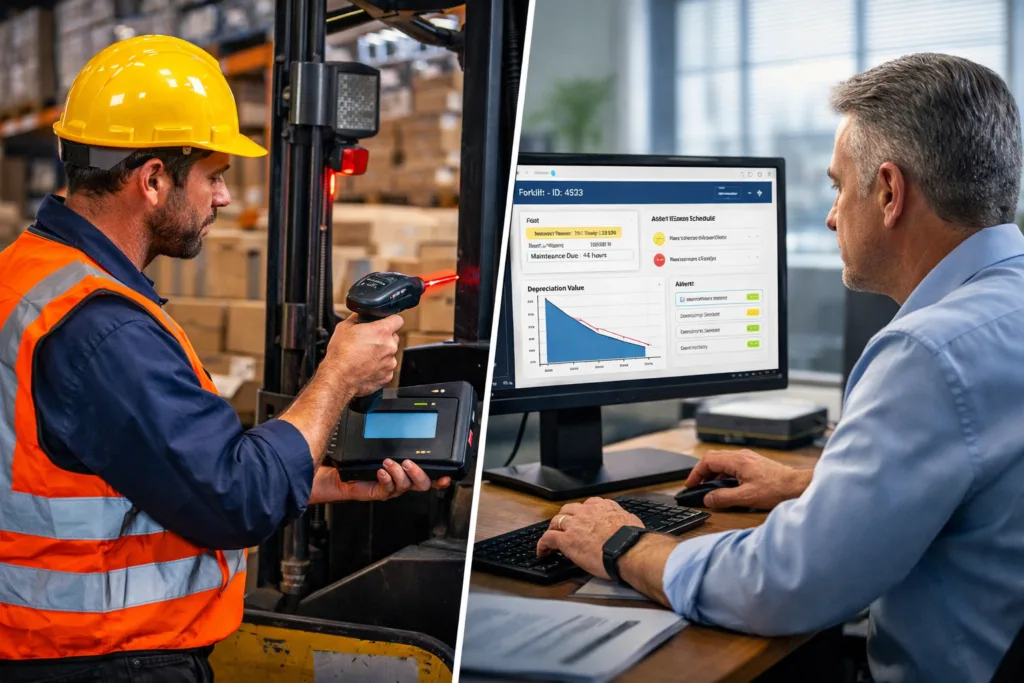
With stricter compliance and rising operational costs in 2026, relying on manual spreadsheets is no longer sustainable. A lost piece of heavy machinery or an unmaintained medical device isn’t just an inconvenience—it is a massive financial liability. In healthcare, using a machine that missed its calibration date can risk patient safety. In construction and logistics, spending hours searching for misplaced tools paralyzes your daily output.
To regain control, you must move to a digitized solution—whether that is dedicated asset tracking software Australia or a comprehensive asset management system Australia. But first, you need to understand exactly which software architecture solves your specific operational pain points.
The Transformation: Before vs. After Digitizing Your Assets
Whether you implement an asset management system, an asset tracking system, or a hybrid of both, the operational shift is immediate and highly measurable.
The "Before" Scenario (Manual Processes):
- Ghost Assets: Paying taxes and insurance on equipment that was lost or stolen years ago.
- Costly Downtime: Machines break down unexpectedly because preventative maintenance schedules were forgotten.
Before” Scenario (Manual Processes):
- Wasted Labor: Staff spend hours every week walking the warehouse floor trying to locate specific scanners, laptops, or tools.
The "After" Scenario (Automated Systems):
- Total Visibility: Live dashboards show you the exact location and custodian of every asset.
- Maximized Lifespans: Automated alerts trigger maintenance before a machine breaks down.
- Audit-Ready Data: Financial teams can instantly pull accurate depreciation and lifecycle reports with a single click.
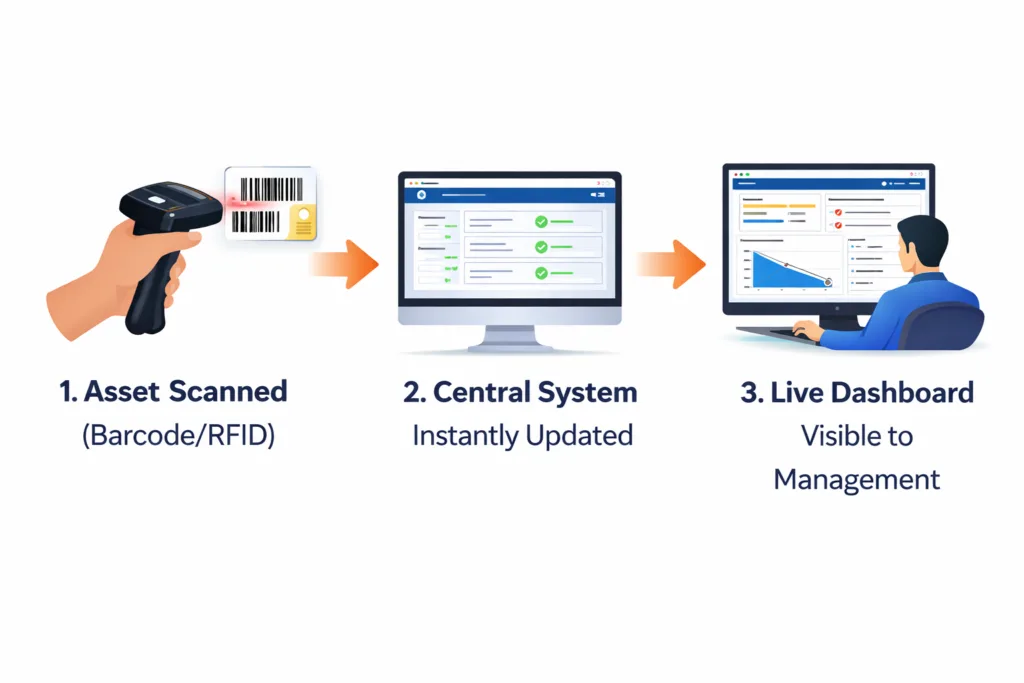
Feature Breakdown: Tracking vs. Management
To make the right procurement decision, it is essential to understand where the operational boundaries of these two software types lie.
Asset Tracking System (The “Where” and “Who”)
Tracking is highly operational. It relies heavily on physical data capture hardware like Zebra Printers to generate tags, and Honeywell Scanners to read them.
- Core Technologies: Barcodes, QR Codes, RFID tags, BLE (Bluetooth Low Energy), and GPS.
- Primary Goal: To prevent loss, theft, and hoarding by answering: Where is it? Who checked it out? When is it due back?
Asset Management System (The “How” and “How Much”)
Management is highly strategic. It takes the location data provided by tracking and layers financial and operational workflows on top of it.
- Core Technologies: Cloud-based software, ERP integrations, predictive IoT sensors.
Primary Goal: To maximize ROI by answering: How much is this worth now? When does its warranty expire? When is its next scheduled service?
Side-by-Side Comparison
| Feature/Requirement | Asset Tracking System | Asset Management System |
|---|---|---|
| Primary Focus | Real-time location and movement | Full lifecycle, maintenance & finance |
| Hardware Reliance | High (Barcodes, RFID, GPS) | Medium (Software & ERP focused) |
| Maintenance Scheduling | ✖ No | ✔ Yes (Automated workflows) |
| Depreciation Tracking | ✖ No | ✔ Yes (Financial reporting) |
| System Integration | Limited (Standalone app) | ✔ Full ERP & Finance Integration |
| Best User Persona | Warehouse Floor Managers | CFOs & Operations Directors |
Industry Use Cases in 2026
How do modern Australian industries utilize these systems?
- Healthcare & Hospitals: Use tracking to instantly locate mobile IV pumps across wards, and use management to ensure every MRI machine undergoes mandatory compliance servicing.
- Construction & Field Services: Use tracking to see which contractor checked out expensive power tools, preventing site-to-site theft.
- Manufacturing: Use management to monitor the lifecycle of assembly line robots, triggering predictive maintenance to avoid catastrophic line shutdowns.
Common Concerns: Implementation & ROI
Procurement teams often hesitate to upgrade due to the perceived difficulty of rolling out a new software architecture.
- “Will it take months to implement?” No. Modern cloud-based systems can be deployed rapidly. Tagging your physical inventory is the most time-consuming step, but with the right industrial barcode hardware, this process is highly streamlined.
- “Is the ROI actually there?” Absolutely. Most Australian businesses recover their initial software and hardware investment within 6 to 8 months simply by eliminating the “ghost assets” they are currently paying unnecessary taxes on, and by preventing duplicate equipment purchases.
- “Do we need two separate software packages?” Rarely. The best enterprise solutions on the market today natively combine real-time tracking modules with deep lifecycle management capabilities.
Why Datascan is Your Premier Australian Partner
Sourcing your enterprise software and hardware through a trusted local partner ensures a smooth, uninterrupted transition. Unlike generic, off-the-shelf software vendors, Datascan provides end-to-end integration backed by decades of local expertise.
Datascan vs. Generic Software Vendors
| Feature | Datascan Integration | Generic Providers |
|---|---|---|
| Local Australian Support | ✔ Yes (24/7 dedicated local team) | ✖ No (Overseas, delayed ticketing) |
| Hardware Guarantee | ✔ Seamless pairing with major scanner brands | ✖ Hit or miss API connections |
| Holistic Approach | ✔ We supply the software, labels, and scanners | ✖ Software only |
Every lost asset, every missed service, and every delayed audit silently drains your profitability. The right system doesn’t just fix operations—it gives you complete control over your business.
Frequently Asked Questions
Can an asset management system perform asset tracking?
Yes, In 2026, most premium enterprise asset management (EAM) systems include robust asset tracking modules built-in, allowing you to handle financial lifecycles and physical location tracking within a single platform.
What is the best technology for tracking physical assets?
It depends on your environment. For basic indoor tracking and check-in/check-out, standard barcodes and 2D scanners are highly cost-effective. For automated, high-volume tracking without direct line-of-sight, RFID (Radio Frequency Identification) is the superior choice.
Why is tracking asset depreciation important?
Tracking depreciation is crucial for accurate financial reporting, taxation, and insurance purposes. An asset management system automates this math, ensuring you do not pay taxes or premiums on equipment that has lost its value or is no longer in use (ghost assets).
Is this software suitable for small businesses?
Yes, While enterprise systems handle massive scale, scalable cloud-based versions are incredibly beneficial for growing businesses. If your team is wasting hours looking for tools, or you have lost thousands of dollars to misplaced equipment, the software will quickly pay for itself.
